

Best Tactical Equipment for Professionals: 2026 Guide
27th Aug 2026
Table of Contents
- Everyday Carry (EDC) Essentials and Duty Gear for Professionals
- Tactical Backpacks, Storage, and Hydration Systems
- First Aid, Trauma Kits, and Optic Protection
- How to Organize Tactical Equipment for Fast Access
Last Updated: August 26, 2026
Choosing the best tactical equipment for professionals means selecting gear that integrates cleanly, holds up under real field conditions, and keeps you mission-ready when it counts. At SENTRY Products Group, we deliver high-quality protective gear and accessories supporting two unique markets. First tactical nylon for military and law enforcement and second firearm and optic covers for the outdoor and hunting markets. For more than two decades our unique designs and durable construction provides reliable performance for professionals and outdoor enthusiasts alike, offering enhanced organization and accessibility. Our USA based manufacturing equip you with the essential tools to secure your gear and excel in any environment. Our goal is simple. At SENTRY, We Live to Protect.
This guide covers every major category, from tactical apparel and load-bearing systems to trauma kits and optic protection, with a focus on technical standards, modular integration, and long-term durability.
Quick Picks:
- Best for Load Management: Modular plate carrier with MOLLE system and quick-release buckles
- Best for Daily Duty Use: Rigid-lined tactical belt with integrated holster and retention pouches
- Best for Field Readiness: IFAK trauma kit with tourniquet and hemorrhage control supplies
- Best for Optic Protection: Scopecoat covers for rifles and spotting scopes exposed to rough handling
Essential Tactical Clothing and Apparel
Tactical apparel is the foundation of any professional loadout. Ripstop nylon and polyester blends dominate because they resist tearing under load, dry quickly, and hold their shape through repeated wash cycles. Stretch panels at the elbows, knees, and seat allow full range of motion without bunching under a plate carrier.
Fit relative to your load-bearing equipment matters more than the fabric spec sheet. Size up one in the torso when pairing with a carrier, and choose pants with a gusset crotch if you are running, climbing, or working from a vehicle.
Key features to prioritize:
- Ripstop or double-weave construction at high-wear zones
- Low-profile pockets that do not interfere with a plate carrier's cummerbund
- IR-compliant or non-reflective fabric options for low-visibility operations
- Articulated knees and elbows for ergonomic movement under load
- Moisture-wicking interior panels for extended wear in warm environments
Seam placement and waistband construction matter as much as fabric weight for professionals wearing tactical clothing on 10-12 hour shifts.
National Institute of Justice standards for protective apparel
Load-Bearing Equipment, Plate Carriers, and MOLLE Systems
A plate carrier is the centerpiece of any tactical equipment setup. The right carrier distributes ballistic protection and mission-critical accessories across your torso without restricting mobility or creating pressure points that degrade performance over a long shift.
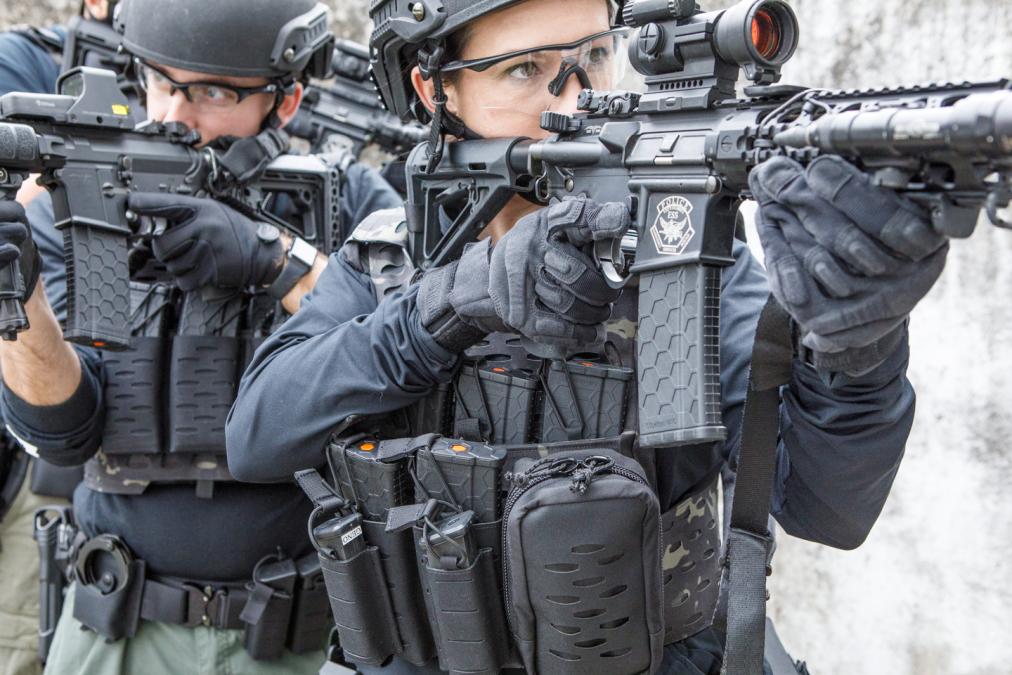
The MOLLE system, Modular Lightweight Load-carrying Equipment, is the attachment standard that makes modern plate carriers genuinely useful. In traditional MOLLE set-ups webbing runs in rows across the front, back, and side panels of a carrier, allowing operators to attach pouches, holsters, admin panels, and hydration systems in a configuration that matches their specific mission profile. Todays standard is a bit different. With the advent of higher grade materials surfaces can be cut to replicate the original ladder system This reduces weight and provides a cleaner look. At SENTRY Products Group you will see that the pattented 1082 mounting system expands the capabilities of the original webbing system and provides for 4 times greater gear placement options. This makes a significant difference in operators placing gear where necessary rather than where the ladder system dictates.
Ballistic Protection Standards: What to Look For
Ballistic protection for plate carriers in the United States is rated by the National Institute of Justice under NIJ Standard 0101.07, which defines protection levels for body armor. The current standard classifies plates from Level II through Level IV, with Level III plates stopping most rifle threats and Level IV plates rated for armor-piercing rifle rounds. Soft armor inserts rated at Level IIIA handle handgun rounds and are commonly used in concealable carriers for plainclothes professionals.
The NIJ rating is a minimum floor, not a complete performance picture. Stand-alone versus in-conjunction-with ratings, plate curvature, and shooter versus SAPI cut geometry all affect how a plate performs inside a specific carrier. Verify compatibility before buying plates and a carrier from different manufacturers.
Integration and Modularity: Building a Mission-Ready Rig
A mission-ready rig is built around a logical attachment hierarchy. Start with the plate carrier shell and cummerbund, then add only the pouches your specific role requires. Overloading a carrier creates a rig that is heavy, slow to access, and fatiguing over a full duty cycle.
Recommended build sequence for a modular MOLLE rig:
- Mount primary magazine pouches at the dominant-hand side for a natural draw angle
- Position a medical pouch on the non-dominant side for cross-draw access under stress
- Attach a radio or communication pouch at the upper chest where antenna placement is unobstructed
- Add an admin pouch for maps, pens, and mission documentation
- Route hydration system tubing through the cummerbund before finalizing pouch placement
- Confirm all quick-release buckles are unobstructed and functional before fielding the rig
Tactical Footwear, Boots, and Ergonomics for Long-Term Wearability
The biggest mistake professionals make with tactical footwear is prioritizing ankle support over ground feel without accounting for terrain and duration. A high-cut boot provides excellent ankle support on uneven terrain but will fatigue the lower leg faster on flat concrete during a 12-hour patrol.
Tactical boots for professional use fall into three practical categories:
Boot Type | Best For | Key Spec | Trade-off |
|---|---|---|---|
High-cut with side zipper | Patrol, field operations | Full ankle wrap, 8-inch height | Heavier, slower to ventilate |
Mid-cut hybrid | Range day, mixed terrain | Balance of support and mobility | Less ankle protection |
Low-cut tactical shoe | Urban duty, vehicle operations | Lightweight, fast to don | Minimal ankle support |
Abrasion-resistant leather and 500D or 1000D nylon uppers are the construction standards worth paying attention to. Full-grain leather resists cuts and abrasion better than synthetic panels but adds weight and requires more break-in time. Vibram or similar outsoles provide grip on wet and loose surfaces without excessive lug depth that traps debris.
Long-term wearability comes down to the insole and midsole stack. Look for removable insoles so you can substitute an orthotic, and a midsole with enough cushion to absorb impact without compressing flat within a few months of regular use.
Everyday Carry (EDC) Essentials and Duty Gear for Professionals
Everyday carry is the layer of tactical equipment you have on your person at all times. For most professionals, EDC centers on a reliable handgun, a holster that provides consistent retention and a repeatable draw, and a small collection of support tools that fit within a concealment or duty belt setup.
Tactical Belts, Holsters, and Pouches
A tactical belt is the structural backbone of any duty rig. A rigid-lined or double-layer belt distributes the weight of a holstered handgun, spare magazines, a flashlight, and a tourniquet holder without sagging or rotating during movement. Nylon and polymer-reinforced belts hold their shape under load; standard dress belts do not.
Holster selection for professionals comes down to retention level and draw geometry. Level II retention holsters are the baseline for active duty, requiring a deliberate release motion before the draw. Level III retention adds a second locking mechanism and is common for uniformed officers in higher-risk environments.
Pouch placement on a duty belt follows the same logic as a plate carrier: organize by access priority and draw angle. A tourniquet pouch belongs at the 9 or 3 o'clock position for cross-draw access. Spare magazine pouches sit at the dominant-side front. A personal defense tool or OC spray holder goes at the non-dominant side rear.
Tactical Lighting, Eye Protection, and Hearing Protection
Tactical lighting, eye protection, and hearing protection are the three most commonly under-specified items in a professional loadout, and the three most likely to matter when conditions degrade.
Tactical flashlights for duty use should produce at minimum 500 lumens with a strobe mode and a runtime of at least two hours on high. Weapon-mounted lights for handguns and long guns are separate from handheld carry lights; a professional loadout includes both.
Eye protection for field use and range day must meet ANSI Z87.1 impact resistance standards at minimum. Ballistic-rated eyewear tested to MIL-PRF-31013 military ballistic lens standard provides a higher protection threshold for environments where fragmentation is a realistic threat.
Hearing protection for range use should achieve a Noise Reduction Rating of at least 22 dB for passive muffs, or use electronic amplification to maintain situational awareness while attenuating gunshot impulse noise.
Tactical Backpacks, Storage, and Hydration Systems
A tactical backpack is a mobile extension of your load-bearing equipment. The best tactical backpacks for professional use integrate with a plate carrier's MOLLE system, allowing the pack to attach directly to the back panel of the carrier for a unified rig that does not shift during movement.
Capacity selection depends on mission duration. A 20-25 liter pack covers a day patrol or range session. A 35-45 liter pack accommodates multi-day field operations with sleeping gear and rations.
Hydration system integration is a non-negotiable feature for any pack used in field environments. A dedicated hydration sleeve that positions a 2-3 liter reservoir at the back panel keeps water weight centered and low, reducing fatigue compared to carrying water in exterior pockets. Route the drinking tube through a shoulder strap channel to keep it accessible without removing the pack.
Gear organization inside a tactical pack follows a priority-access principle: items you need fastest go in the most accessible pockets. Trauma kit supplies belong in an exterior pocket with a pull-tab zipper, not buried inside the main compartment.
First Aid, Trauma Kits, and Optic Protection
Every professional tactical loadout requires a dedicated Individual First Aid Kit. An IFAK is not a general-purpose first aid kit; it is a hemorrhage control kit configured specifically to address the most common causes of preventable death in tactical environments: extremity bleeding, airway obstruction, and tension pneumotharax.
A mission-ready IFAK contains:
- Tourniquet rated for extremity use
- Pressure bandage or wound packing gauze
- Chest seal with vented design for penetrating chest wounds
- Nasopharyngeal airway adjunct
- Medical gloves and trauma shears
TCCC, Tactical Combat Casualty Care, guidelines, maintained by the Committee on Tactical Combat Casualty Care, define the current evidence-based standard for field trauma management. Professionals should train to these guidelines, not just carry the supplies.
Optic protection is a category that does not get the attention it deserves in most tactical gear guides. A quality rifle scope, red dot sight or night vision goggles represents a significant investment. Scopecoat optic covers from SENTRY Tactical provide a purpose-built solution: durable covers that protect objective lenses, eyepieces, and exposed turrets from impact, debris, and moisture during transport and field use.
How to Organize Tactical Equipment for Fast Access
Gear organization is where most loadouts fail. A professional can own excellent individual pieces of tactical equipment and still lose critical seconds because the kit is not organized around how the body moves under stress.
The core principle: organize by access priority, not by size or weight. Items you need fastest, a tourniquet, a handheld light, a spare magazine, must be reachable without looking, without changing your grip on a primary weapon, and without removing any other piece of gear first.
Gear organization requires field maintenance discipline. A MOLLE pouch that has shifted on its attachment points, a holster retention screw that has backed out, or a hydration tube that has kinked are all failure points that degrade performance. Build a pre-mission inspection into your routine: check every attachment point, every retention device, and every zipper before you step out.
Your kit should evolve as your role, environment, and threat assessment change. Run a quarterly audit against your loadout checklist, replace any consumables that have been used or expired, and adjust pouch placement if your primary mission profile has shifted. Clean MOLLE webbing and attachment hardware after field use, inspect stitching at high-stress attachment points, and store carriers unloaded and flat to prevent cummerbund deformation.
Building the best tactical equipment loadout for professionals is a deliberate process, not a single purchase. SENTRY Tactical offers a comprehensive range of tactical gear, pouches, designed for mission-critical use, durable construction, purpose-built organization, and reliable performance in field environments. Visit the SENTRY Tactical website at www.sentrytactical.com to explore current product availability and configure a loadout that matches your specific operational requirements.
Frequently Asked Questions
What tactical equipment do professionals use for daily duty?
Most professionals — law enforcement, security, and first responders — carry a duty belt with holster, spare magazine pouches, and a tactical flashlight at minimum. Field deployments add a plate carrier with ballistic protection, a trauma kit, and a modular backpack or hydration system. The exact loadout depends on the role, but every professional-grade setup prioritizes quick-release hardware, abrasion-resistant materials, and MOLLE compatibility so the rig can be reconfigured as the mission changes.
What is the difference between civilian and professional-grade tactical gear?
Professional-grade tactical equipment is built to tighter tolerances, tested against recognized standards such as NIJ ballistic ratings, and designed for extended daily wear rather than occasional range days. Stitching, hardware, and fabric are typically heavier-duty — ripstop nylon, reinforced stress points, and corrosion-resistant hardware. Civilian-market gear varies widely in quality. The practical difference shows up under sustained load: professional-grade equipment holds its shape, retains positive control of pouches and accessories, and lasts significantly longer before showing wear.
How do you choose reliable tactical equipment for field operations?
Start with the mission profile: the environment, duration, and threat level determine which categories of gear matter most. Prioritize load-bearing equipment and footwear first, since those affect mobility and endurance the most. Verify that plate carriers meet NIJ standards if ballistic protection is needed. Check that pouches use genuine MOLLE-compatible webbing for modular attachment. For optics, add a protective cover rated for the conditions you expect. Avoid gear with vague specifications — reputable tactical equipment lists materials, weight ratings, and compatibility clearly.
How should tactical gear be maintained for longevity and performance?
Field maintenance starts immediately after use. Brush loose debris from MOLLE webbing and Velcro before it embeds. Wipe down metal hardware with a dry cloth to prevent corrosion. Wash fabric components according to the manufacturer's label — most ripstop nylon and nylon-blend carriers tolerate cold-water machine washing without a dryer. Inspect stitching at stress points and buckle connections after every hard use. Optic covers and scope caps should be wiped with a clean microfiber cloth and stored away from prolonged UV exposure to prevent material degradation.
Is a plate carrier worth it for range use rather than professional duty?
For regular range days, a plate carrier without ballistic plates functions as a load-bearing vest that lets you practice drawing from realistic positions, train with the weight you'd carry operationally, and organize magazines and accessories exactly as you would in the field. Many shooting sports enthusiasts find that training with a carrier improves their practical accuracy and reload speed. You don't need plates for range work — the ergonomics and organization benefits apply regardless of whether the carrier is loaded with ballistic inserts.
This article was written using GrandRanker