

Best Scope Covers for Hunting: 2026 Guide
27th Aug 2026
Table of Contents
- Why Scope Covers Matter for Hunting Optics
- Flip-Up vs Slip-On Scope Covers: Which Style Works Best?
- Neoprene Scope Cover Benefits for Field Use
- How to Measure Your Rifle Scope for Covers
- Top Scope Covers for Hunting: Reviewed by Type
- Scope Cover Fitment Matrix: Matching Cover to Objective Lens Size
- Maintenance, Weight, and Field Repair of Scope Covers
- Choosing the Best Scope Covers for Your Hunting Setup
Last Updated: August 26, 2026
Why Scope Covers Matter for Hunting Optics
A quality rifle scope demands protection from mud, dust, rain, and impact. Scope covers prevent the fogged or scratched lenses that hunters discover at the worst possible moment, shielding both objective and ocular lenses from environmental damage during transport, field deployment, and storage.
Optical coatings on modern hunting scopes are precision-applied and chemically sensitive. A single grit-laden wipe can degrade light transmission in ways that are not obvious until you need to resolve a target at distance. Covers eliminate that risk entirely while protecting the parallax adjustment turret and eye relief zone from debris and moisture, reducing the need for frequent lens cleaning and providing impact protection in dense terrain.
According to the Sporting Arms and Ammunition Manufacturers' Institute, proper optics maintenance is a core component of firearm safety and accuracy standards, and protective accessories are considered part of that ecosystem.
Scope covers are inexpensive insurance for expensive glass. The question is not whether to use one, but which type fits your hunting environment.
Flip-Up vs Slip-On Scope Covers: Which Style Works Best?
Flip-up caps and slip-on sleeves solve the same problem from different angles. Flip-up caps prioritize speed and precision access; slip-on covers prioritize full-envelope protection. Your choice depends on how you hunt and what conditions you face.
Flip-Back Caps: Speed and Precision Under Pressure
Flip-back caps are hinged lens covers that mount directly to the scope's objective and ocular housings. A single thumb motion opens them, leaving the lens instantly clear for a shot, zero fumbling, zero removed parts, zero dropped caps in snow.
Quality flip-up caps use precision-machined rings or adapter threads that mount to the scope body. Hinge tension is adjustable on better models, which matters significantly. Too loose, and brush contact opens the cap. Too tight, and one-handed operation becomes impossible under pressure.
Flip-back caps are preferred for spot-and-stalk hunting where rapid target acquisition is critical, tactical and long-range shooting where reticle access speed matters, and cold-weather hunting where gloves make fumbling problematic. The limitation is coverage: they protect the lenses but leave the scope tube exposed to moisture and abrasion. Also if moisture gets trapped under the flip-up cap you have basically created a terrarium.
Slip-On and Neoprene Sleeve Covers: Full Envelope Protection
Slip-on covers and neoprene sleeves encase the entire scope in a protective layer, providing cushioned impact protection, weather-sealed coverage across the full tube, and moisture-wicking properties that flip-up caps cannot match. The trade-off is deployment speed, a neoprene sleeve must be removed before shooting. For hunters glassing from a fixed position or waiting in a stand, or riding in a vehicle that trade-off is acceptable.
Neoprene Scope Cover Benefits for Field Use
Neoprene is a closed-cell synthetic rubber providing properties that rigid caps cannot replicate. Impact protection absorbs shock, protecting against zero shift or internal damage from hard knocks or drops. Moisture management repels water rather than absorbing it, keeping the scope body, adjustment turrets, battery compartments, and seals dry. Temperature insulation provides a thin thermal buffer between the scope tube and extreme cold, slowing temperature transitions and reducing fogging risk.
Fitment is easy. Always match the sleeve to both the objective lens diameter and overall scope length for full coverage without bunching.
How to Measure Your Rifle Scope for Covers
Correct fitment is easy when buying scope covers. A cover should stretch to fit for proper coverage and a neoprene cover will have 10% stretch to accomodate manufacturing differences.
Scope covers are sized primarily by objective lens diameter, and requires only two dimensions:
Measurement | What to Measure | Why It Matters |
|---|---|---|
Objective lens diameter | Outer diameter of the objective bell | Determines cap or sleeve opening size |
Overall scope length | Front of objective bell to rear of eyepiece | Required for full-sleeve neoprene covers |
Use digital calipers for accuracy. One critical detail: the objective bell diameter is almost always larger than the objective lens diameter. A scope with a 50mm objective lens will have a bell measuring 58-65mm depending on the manufacturer. Measure the bell, not the lens.
Top Scope Covers for Hunting: Reviewed by Type
Choosing the right scope cover depends on hunting style, environmental conditions, and how fast you need to transition from carry to shot.
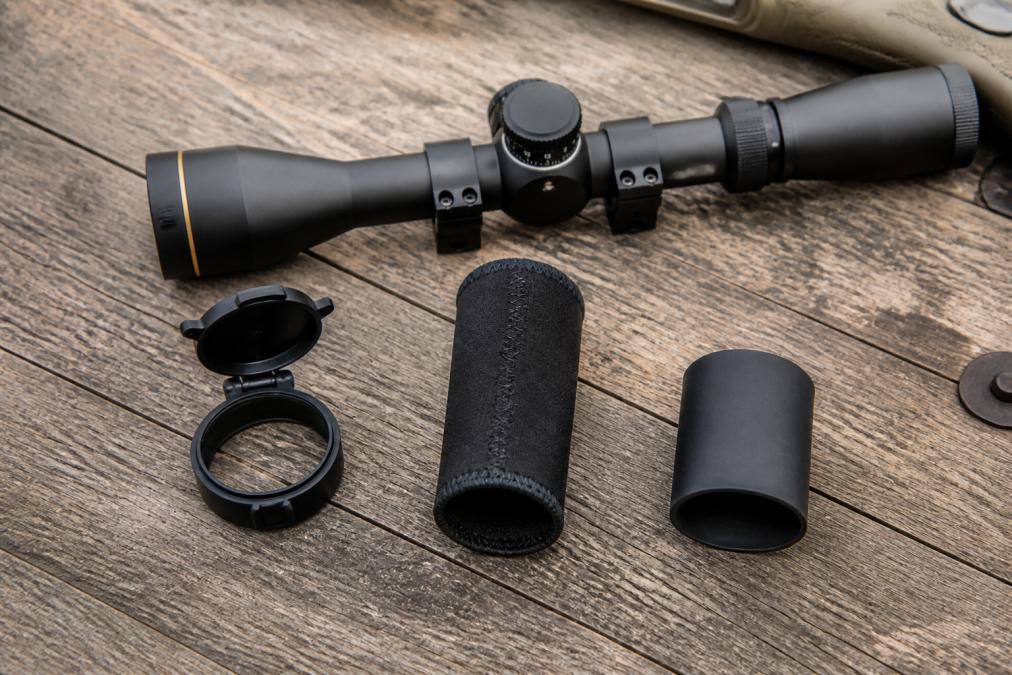
Best Flip-Up Lens Cap Systems
Flip-up lens cap systems are the field-ready standard for hunters prioritizing speed. The best systems share three characteristics: positive hinge tension that holds the cap open and closed without drift, precision-machined adapter rings that do not shift under recoil, and a low profile that does not add meaningful weight to the front of the rifle.
Look for adjustable hinge tension (critical for cold-weather use with gloves), quick-detach capability for full lens cleaning access, compatibility with objective bells from 40mm to 56mm, and a dust-proof seal when closed.
SENTRY Products Group Scopecoat optic covers combine durable construction with field-ready reliability for hunters and tactical shooters depending on extended field operations. This USA Made cover has been the industry standard for more than 25 years and comes with a lifetime warranty.
Best Neoprene Covers
For hunters prioritizing full-envelope protection over deployment speed, neoprene sleeve covers are the correct choice. A properly fitted it covers the entire scope from objective bell to eyepiece, providing cushioned protection, weather resistance, and thermal buffering.
The best neoprene sleeves use reinforced stitching at stress points where material is most likely to tear after repeated use. Look for double-stitched seams and material thickness of at least 3mm for meaningful impact protection.
Best for tree stand hunters who can remove the sleeve before the shot, transport protection in saddle scabbards and hard cases, wet-weather hunting in rain or snow, and precision rifle setups where zero protection from impact is the priority.
Pros: Full-scope coverage including tube and turrets, impact absorption, weather-sealed against rain and snow, protects reticle illumination battery compartments.
Cons: Must be removed before shooting, sizing must be precise, adds slightly more weight than cap-only systems.
Best Budget Slip-On Caps
Slip-on rubber caps are the simplest form of scope protection, fitting over objective and ocular lenses individually and held in place by friction. No mounting hardware, installation, or adjustment required.
Budget slip-on caps are appropriate for storage and short-duration transport, not active field use. For a rifle that lives in a safe between hunts, they are adequate. For regular field use, they are a starting point, not a solution.
Pros: Low cost, no installation required, universal fit across objective diameter ranges, adequate for storage.
Cons: No retention in active field use, zero impact protection, no weather seal beyond basic lens coverage, easy to lose.
According to the American Rifle Association's optics maintenance guidance, using improperly fitted accessories on precision optics is a leading cause of preventable damage to scope housings and internal adjustment mechanisms.
Maintenance, Weight, and Field Repair of Scope Covers
A scope cover that is not maintained correctly stops doing its job, and one that fails in the field needs a fix that does not require a hardware store.
Cleaning scope covers is straightforward. Neoprene sleeves should be hand-washed with mild soap and cold water after muddy or wet hunts. Flip-up caps can be wiped down with a damp cloth; pay attention to the hinge pivot point where grit accumulates. A drop of lightweight oil on the hinge pin once per season keeps the mechanism operating smoothly.
Weight considerations matter most on precision long-range setups. A standard neoprene sleeve adds minimal weight, typically under 30 grams. Flip-up cap systems vary depending on adapter ring material: aluminum rings are lighter than steel and adequate for most hunting applications.
DIY field repairs are simple with the right materials. The most common failure is a torn neoprene seam at the objective bell opening. Self-adhesive neoprene tape can patch a torn seam and restore weather resistance in minutes. For flip-up caps, a lost hinge spring can be temporarily replaced with a small rubber band looped through the hinge pivot.
Choosing the Best Scope Covers for Your Hunting Setup
The best scope covers are not the most expensive or technically complex. They are the ones you will actually use consistently, which means matching the cover type to your specific hunting style and environment.
If you hunt from a fixed position (stand, blind, glassing point): A neoprene sleeve is the right primary cover. Deploy it during transport and while waiting. Remove it when you transition to active shooting.
If you hunt actively (spot-and-stalk, driven hunts, dense cover): Flip-up caps are the correct choice. The speed advantage is real and meaningful. Pair them with a neoprene sleeve for transport if terrain is particularly rough.
If you are protecting a precision long-range setup: Prioritize impact protection above all else. A neoprene sleeve with reinforced seams, sized precisely to your scope, provides the cushioned protection that a precision-machined optic needs when not behind the rifle.
If budget is the primary constraint: Slip-on caps for storage and a single well-fitted neoprene sleeve for field use give you meaningful protection at the lowest cost, covering the most common damage scenarios.
As noted in Field & Stream's hunting gear maintenance guide, hunters who establish consistent pre- and post-hunt gear maintenance routines, including optics protection, report significantly fewer equipment failures during critical field moments.
Measure your scope before you buy. A cover that fits correctly and gets used every time is worth more than a premium cover sitting in a drawer.
The right combination of scope cover protection is one of the simplest upgrades a hunter can make to their optics system. Optical integrity depends on how consistently you protect it from the moment you leave the truck to the moment you take the shot.
Protecting a quality scope is a long-term investment decision. Damage from unprotected field use, scratched coatings, moisture-compromised seals, impact-shifted zeros, is expensive to repair and often irreversible. SENTRY Tactical's Scopecoat optic covers combine durable construction with field-ready design for hunters and tactical shooters who cannot afford equipment failures when it counts. Explore the full range of protective gear and register your account to find the right cover for your setup.
Frequently Asked Questions
Do you really need scope covers for hunting?
Yes. A rifle scope exposed to rain, mud, dust, and brush contact during a hunt can suffer scratched lenses, fogged glass, or damaged turrets in a single outing. Even a modest drop or branch strike can compromise optical integrity enough to shift your zero. Scope covers cost a fraction of what a quality optic costs to repair or replace, and they take seconds to fit. For anyone hunting in rugged terrain or inclement weather, they are essential protective gear, not optional accessories.
What is the difference between scope caps and scope covers?
Scope caps are individual lens covers — typically flip-up or push-on — that protect only the objective or ocular lens. Scope covers, such as neoprene sleeves, wrap the entire body of the optic, shielding the tube, turrets, and both lenses from impact, moisture, and debris. Caps prioritize fast deployment and are common in tactical and long-range shooting setups. Full sleeve covers offer more comprehensive cushioned protection and suit hunters who store or transport rifles in rough conditions.
How do I choose the right size scope cover for my optic?
Measure your objective lens diameter in millimeters — it is usually printed on the scope body (e.g., 4-12x44 means a 44mm objective). Also measure the outer diameter of the objective bell, not just the lens itself, since the bell housing adds several millimeters. For neoprene sleeves, measure overall tube length too. Most manufacturers list compatible objective lens sizes in their fitment charts. When in doubt between two sizes, the snugger fit provides better dust-proof and moisture-wicking performance without slipping during field deployment.
Are neoprene scope covers better than hard plastic caps?
They serve different purposes. Neoprene sleeve covers absorb impact, insulate against temperature swings, and protect the full optic body — ideal for transport and storage in rugged terrain. Hard flip-up or snap-on plastic caps protect only the lenses but allow faster access to the reticle and parallax adjustment controls. Many hunters use both: a neoprene sleeve during transport and flip-up caps during the hunt itself. The best choice depends on how quickly you need your optic ready and how much handling abuse your gear typically takes.
Do scope covers affect reticle illumination systems or turret access?
Full neoprene sleeve covers can cover illumination controls and turret caps, which matters if you need to adjust settings quickly in low light. Look for sleeves with cutouts or zipper panels that expose the turret area and battery compartment. Flip-up caps leave the scope body fully accessible, so they are the better choice for scopes with active reticle illumination systems where fast adjustments are part of your field routine. Always check the cover's design against your specific scope model before purchasing.
This article was written using GrandRanker